
Is €275bn enough to weatherproof Ireland’s infrastructure?
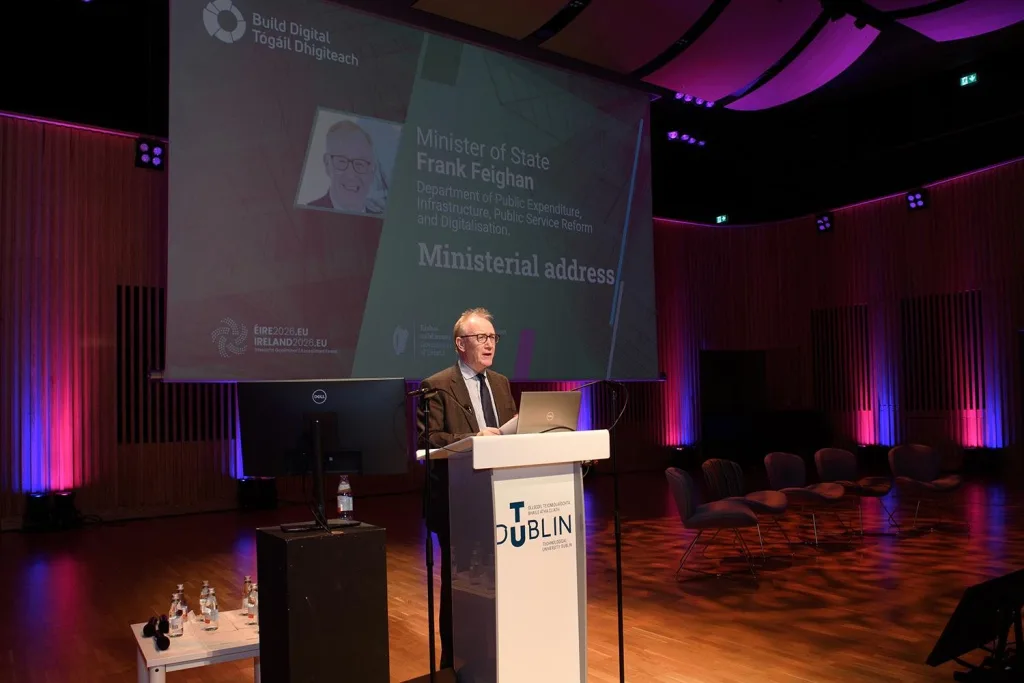
Minister Frank Feighan TD, Met Éireann and TU Dublin told the Build Digital National Conference 2026 that the time to manage climate risk is before assets fail, not after.
The roads, water networks, energy systems and public buildings Ireland commissions under the €275.4 billion National Development Plan will have to keep working for 30, 40 or 50 years through changing weather. That was the message to delegates at the Build Digital National Conference 2026, Infrastructure and the Weather: Climate Resilience and Ireland’s Role in Europe’s Digital Construction Transformation.
The conference took place on Thursday 8 October at the Concert Hall, East Quad, TU Dublin Grangegorman. It was an associated event of Ireland’s Presidency of the Council of the European Union.
Speakers’ shared argument was that the decisions which will settle whether those assets cope are being taken now.
Frank Feighan TD, Minister of State for Public Procurement, Digitalisation and eGovernment, told the conference that the updated National Development Plan provides for €275.4 billion in public capital investment between 2026 and 2035.
He described it as the largest capital investment programme in the history of the State, delivering housing, water and energy infrastructure, and expanded transport networks.
“Ireland is undertaking an infrastructure programme on a scale we have not seen before… But investment alone will not be enough… Infrastructure we commission today may still be in use 30, 40 or 50 years from now, and climate resilience therefore needs to be considered from the outset, in planning, design, development and construction, and in the management of the asset,” Minister Feighan said.
He said digitalisation and building information modelling have an important role to play. “Digitalisation is not an end in itself. The objective is better delivery and better outcomes.”
Keith Lambkin of Met Éireann opened the first session. He set out how infrastructure may need to adapt progressively as future climate conditions become clearer.
A panel then took on a central tension for public clients: how to deliver water, wastewater, transport and other essential infrastructure faster without giving up resilience or long-term fitness for purpose.
The theme running through the day was that owners cannot protect assets they cannot see. Speakers showed how better information can help owners find vulnerable assets, understand their exposure to climate risk, and prioritise investment before failure occurs.
Transport Infrastructure Ireland’s work on climate adaptation of the national road network was one practical example. It combines asset information, risk assessment and climate data to support decisions that will hold for decades.
The programme also covered implementation of the Irish BIM Mandate and ISO 19650, the role of structured, reliable information in managing projects and assets, and the growing use of artificial intelligence in construction.
Afternoon sessions looked at how to build digital capability while keeping governance, transparency and trust, and how technology can support a skilled workforce rather than replace it.
Dr Deirdre Lillis, President of TU Dublin, lead partner of Build Digital, opened the conference.
“The transformation of construction will not be achieved by technology alone. It will depend on people with the skills and confidence to apply new knowledge in practice,” she said.
Dr Lillis said continued investment is needed in physical infrastructure, and equally in the skills, research, knowledge and partnerships needed to deliver it. As both an educator and the owner of a major campus, including the recently opened Academic Hub and Library at Grangegorman, TU Dublin has a direct stake in how infrastructure is planned, delivered and maintained across its full life.
Dr Clare Eriksson, Project Director of Build Digital, said the project’s strength had come from collaboration.
“By bringing government, academia, public clients, industry and the professions together, we have been able to move beyond discussing digital transformation and develop practical supports that organisations can use,” she said. “That partnership approach has been central to the progress made over the past five years.”
The conference closed with representatives of Ireland’s professional and industry bodies reflecting on five years of digital transformation in the sector.
The Build Digital Annual Survey 2026 is the national evidence base on digital adoption across Irish construction and the built environment. Build Digital is asking every organisation and professional in the sector to complete it and pass it on: assessor.io/public/campaign/178659092297407
Build Digital | Tógáil Dhigiteach is a government-funded initiative led by TU Dublin. It works with academic, public-sector and industry partners to support the digital transformation of Ireland’s construction and built environment sector and implementation of the Irish BIM Mandate. Its academic partners are TU Dublin, ATU, MTU, SETU and UCD. www.builddigital.ie