
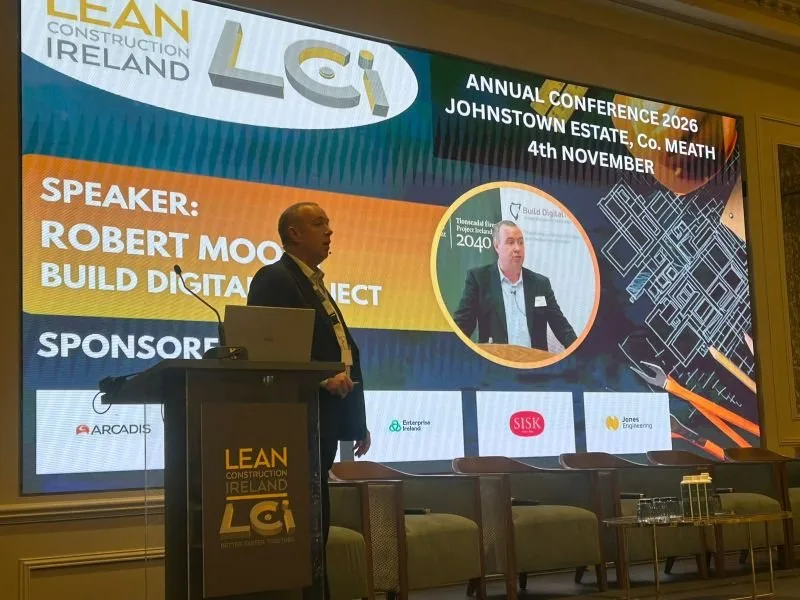
Build Digital Project Lead Robert Moore presented at the Lean Construction Ireland 2026 Annual Conference on Wednesday 4 November, setting out how five years of Build Digital work has taken Ireland’s digital construction ambition from national strategy to practical, proportionate supports for the Irish BIM Mandate.
Robert’s presentation, Productivity, Accelerating Infrastructure Delivery & Digital Transformation, was delivered under the heading Creating Value through Innovation & Disruption (reshaping Construction). It traced the programme from its policy origins to the resources now available to public clients, design teams, contractors and the SME supply chain.
Robert began with the groundwork for a national approach. Three reference points framed it: the public consultation coordinated by the Office of Government Procurement on a BIM adoption strategy for the public sector; the National BIM Council’s Digital Roadmap for the construction sector, which set targets of a 20% reduction in project delivery programmes, a 20% reduction in capital costs and a 20% increase in construction exports; and the Economic analysis of productivity in the Irish construction sector by KPMG and Future Analytics.
Build Digital was established as one of seven innovation actions overseen by the Construction Sector Innovation and Digital Adoption Group, chaired by PJ Rudden and reporting to the Construction Sector Group. The group brings together DPER, Engineers Ireland, BMF, RIAI, CIF, Enterprise Ireland, NSAI, DBEI, SCSI, the LGMA and local authorities, and ACEI.
The seven actions are construction research; productivity and sustainability funding; modern methods of construction; the Construction Technology Centre; Construction Skillnet; ePlanning; and Build Digital, all set within the wider context of Housing for All, the circular economy and sustainability.
In its first two years, Build Digital, hosted at TU Dublin with Atlantic Technological University, Munster Technological University, UCD and South East Technological University, worked to understand what industry needed. That work was organised around five pillars: digital leadership and cultural change; digital standards; digital education and training; digital procurement; and sustainability and climate action.
Years three to five were shaped by the Irish BIM Mandate. Under the Capital Works Management Framework (CWMF), the core BIM requirements for public works projects are the ISO 19650 series, Uniclass, Industry Foundation Classes (IFC) and the International Cost Management Standard (ICMS).
The mandate is being phased in by project value, applying to projects that commence Stage 1 of the CWMF on or after each implementation date. Design teams come first, followed by the contractor and supply chain.
For projects over €100 million, the mandate has applied to design teams since 1 January 2024 and to the contractor and supply chain since 1 January 2025. For projects over €20 million, the dates were 1 January 2025 and 1 July 2025, and for projects over €10 million, 1 July 2025 and 1 January 2026. Design teams on projects over €5 million followed on 1 July 2026, with the contractor and supply chain due on 1 January 2027. Projects over €1 million follow on 1 January 2027 for design teams and 1 July 2027 for contractors, and projects under €1 million on 1 July 2027 and 1 January 2028.
With the design team milestone for projects over €1 million and the contractor milestone for projects over €5 million both falling on 1 January 2027, the mandate is now reaching a far larger share of public projects and a far larger part of the supply chain.
In response, Build Digital restructured around three hubs: Digi Adopt, guiding organisations taking their first steps and the change needed within them; Digi Implement, supporting organisations implementing information management on projects and achieving the mandate; and Digi Innovate, focused on the industry’s competitiveness and new digital advances.
The core of the presentation showed how each set of Build Digital supports answers a gap at a particular stage of the mandate.
Projects over €100 million. At the start of the mandate there was no starting point for delivering large projects. Build Digital developed Information Management Plans to help large national public clients get started with ISO 19650 on large, complex projects. They comprise an Organisational Information Management Plan (organisational, asset and project information requirements); an Appointing Party Information Management Plan (information management responsibilities and exchange information requirements); and a Delivery Team Information Management Plan (BIM execution plan, capability and capacity, mobilisation plan and risk register).
Projects of €5 million to €100 million. Organisations needed a way to build their own capacity to deliver mandate projects. The Adoption Strategy Supports help local authorities, other smaller public clients and their SME supply chain prepare for their first mandate project. They include public and private sector business cases; an adoption roadmap from preparation to implementation; adoption strategies with worked examples for a local authority and a contractor; adoption planning templates; methods for evaluating authoring tools and common data environments (CDEs); and a technology deployment strategy and plan with CDE examples.
Projects under €5 million. Two further gaps remained. For individuals who simply want to do their job well on any mandate project, the Persona Scenario Workflows follow real roles, from an information manager in a public client and a public sector project coordinator to the managing director of an SME main contractor, a consulting design engineer in a small M&E practice, the principal of a small architectural practice and a mechanical installer. For local authorities and smaller public clients delivering their first mandate project through their supply chain, the Delivery Approaches provide a delivery approach guide, risk assessment and responsibility matrix, together with Design Team Lead supports including an activities matrix and standard and complex scopes of services.
Robert also showed the Build Digital Knowledge Navigator, which brings the programme’s materials, research, courses and personas together in one place.
Robert closed by drawing the threads together. The 2017 roadmap laid the foundations for Build Digital’s five-year partnership. Research, surveys and engagement with industry shaped the response to the BIM Mandate. Starting with the public client matters, because clear and purposeful information requirements make proportionate delivery possible. Practical supports, from plans and adoption guidance to personas and delivery approaches, address real needs. And vendor-neutral resources support better decisions and more useful asset information, a lasting contribution to Project Ireland 2040.
Attendees at the conference were invited to take part in the Build Digital Annual Survey 2026, the national benchmark for digital adoption across Irish construction and the built environment. If you work in the sector and have not yet responded, please complete it and share it with colleagues: Take the survey [closing shortly]
Robert Moore has been Project Lead for Build Digital at TU Dublin since its launch in 2022, leading its national mission to accelerate digital adoption across the construction and infrastructure sectors. He works with government, academia and industry to develop practical tools, frameworks and guidance that help organisations meet the Irish BIM Mandate and international standards such as ISO 19650. Internationally, he co-authored CEN/TR 17654:2021, which provides guidance on Exchange Information Requirements and BIM Execution Plans. He is contributing to the review of ISO 19650-1, -2 and -3 and is a member of the openBIM Harmony working group.
Build Digital | Tógáil Dhigiteach is delivered in support of Project Ireland 2040 and the work of the Accelerating Infrastructure, Productivity and Capacity Working Group.